
United Nations
Canada's obligations under International Covenant on Civil and Political Rights

I first wrote to the UN Human Rights in response to a letter I had received from the Canadian Judicial Council claiming that judges could legitimately protect lawyers committing fraud on court orders by rejecting the best evidence that any Canadian could provide to defend themselves, the transcript and could instead prefer the recollection of the Plaintiff instead.
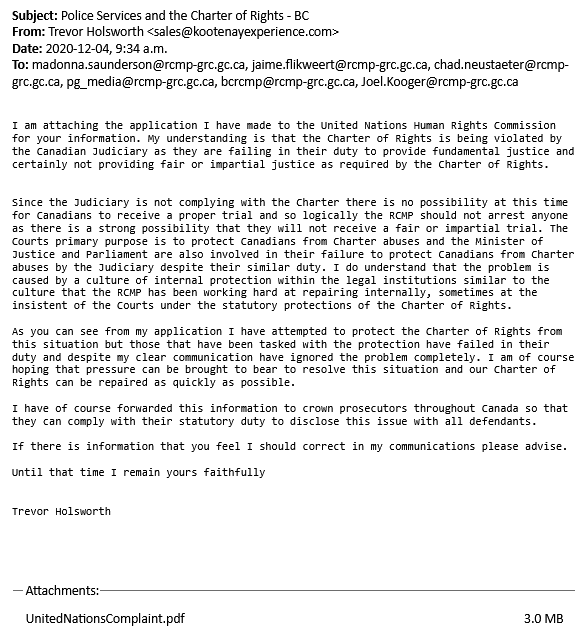
I had sent the complaint to the UN under the Human Rights branch on August 7th, 2020. My position was fairly straightforward.
I have in my possession a reply from the Canadian Judicial Council to a complaint that I made against a Federal Judge. My complaint was that when I presented the official transcript of trial to the Judge he personally called up my ex-wife and accepted the verbal testimony of my ex-wife of what she heard a previous Judge say 6 months earlier over what the transcript of trial indicated. The Canadian Judicial Council indicated that this was a matter of discretion and the weighing of evidence which is not a matter for discipline. I have attached their letter.
I disagree with their finding and find that the result of this determination is that we have a judicial system in Canada which is arbitrary. If Federal Judges have the right to ignore their own transcript of trial then we dont have a system of appeal. If Federal Judges have the right to ignore their own transcript of trial then we have a massive problem with the Canadian Charter of Rights as well as the United Nations Universal Declaration of Human Rights.
S7. Everyone has the right to life, liberty and security of the person and the right not to be deprived thereof except in accordance with the principles of fundamental justice.
It seems very well established that the primary component of fundamental justice is that is NOT arbitrary.
I cannot present better evidence than the transcript of trial. For a judge to decide to ignore the transcript of trial is arbitrary. For the Canadian Judicial Council, the governing body of federal judges to accept that conduct as within their acceptable standard is completely unacceptable. I have pointed this reality to the Canadian Judicial Council but they have refused to respond. I wrote and requested that the Canadian Judicial Council put this issue to Parliament for confirmation that Parliament agrees with this incredible determination. They wrote back and refused and called my request abusive. For obvious reasons it is impossible to make this appeal through the Canadian Courts to police themselves as their governing body the Canadian Judicial Council holds that they have the right to ignore everything that I have to say, and ever piece of information that I can provide up to and including their own transcript of trial…
I cannot attend a court to defend myself or protect myself without further risk to my rights and freedoms.
I laid out the allegations as breaches against the United Nations Charter of Rights, specifically 6, 7, 8, 9, 10, 11, 12 and 13.
I got an acknowledgement of receipt of that letter but nothing else. I noted in my communications with former AG/MOJ David Lametti of that communication so he would know what was coming but he ignored me after I corrected his false and misleading statements.
After the abuse I suffered attempting to achieve resolution through the legal system and the political system I had gathered further evidence of a failure by Canada to comply with their International fair trial rights obligations.
Jul 22 2025
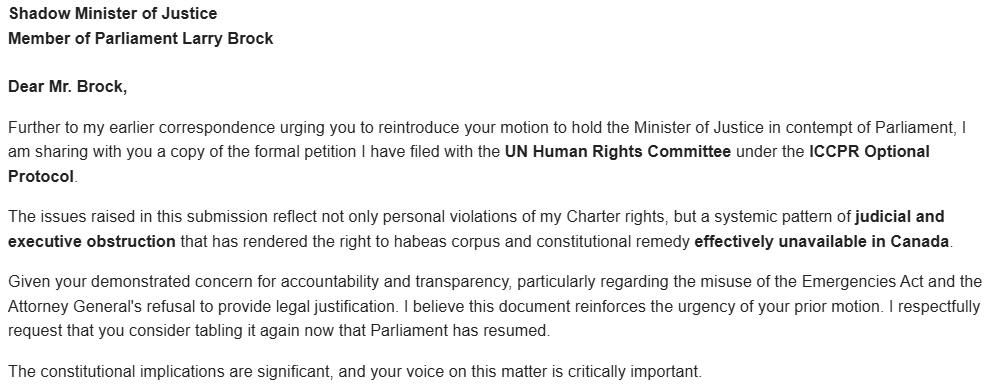
My application was fairly brief and contained these elements.
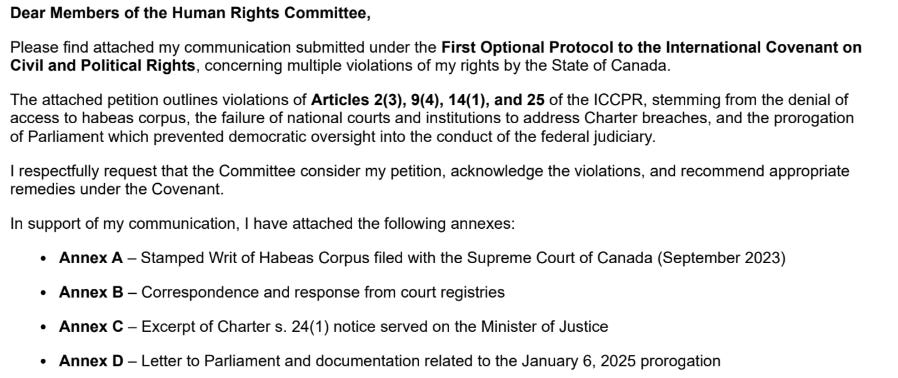
In response the UN sent me their application form and some further instructions to assist in crafting a more comprehensive application which addressed all of their concerns. So I followed their instructions and on July 28, 2025 resubmitted a 50 page plus evidence submission which was fairly comprehensive in the documentation of my experience. This is just the…
Chronological Summary of Main Facts and Domestic Remedies
BACKGROUND EVENTS (2020)
November 2020: I served a Charter s.24(1) enforcement procedure by registered mail on Minister of Justice David Lametti, requesting that documented judicial misconduct be presented to Parliament as the constitutionally appropriate remedy for systematic Charter violations.
November 16, 2020: Prime Minister's Office acknowledged receipt and forwarded the matter to Minister of Justice Lametti, stating they had "carefully reviewed" the constitutional enforcement request.
INITIAL DOMESTIC REMEDIES - EXECUTIVE BRANCH (2020-2022)
February 11, 2021: Minister Lametti responded, claiming he had "no legal authority" to intervene in judicial conduct matters and recommending I seek "legal advice from a lawyer."
February 14, 2021: I responded with detailed legal correction, citing the Department of Justice Act and proper authorities establishing the Minister's constitutional duties. No further response was received.
March 6, 2022: Prime Minister's Office forwarded my constitutional enforcement communications to Minister of Public Safety Marco Mendicino, acknowledging "public safety concerns." No response was received from Mendicino.
CONSTITUTIONAL COMMUNICATIONS - GOVERNOR GENERAL (2021-2022)
October 26, 2021: I wrote to Governor General Mary Simon regarding the constitutional crisis developing from the Minister of Justice's refusal to address systematic judicial misconduct and Charter violations. No response was received.
March 7, 2022: I sent a follow-up letter to the Governor General regarding the minority government's constitutional violations and the need for constitutional oversight. No response was received.
JUDICIAL PROCEEDINGS - PROVINCIAL COURTS (2021-2023)
July 15, 2021: Constitutional questions were properly served on both the Attorney General of BC and Attorney General of Canada regarding the constitutionality of the Judges Act and the failure to respond to Charter s.24(1) enforcement procedures.
July 15, 2021: Both Attorneys General "declined to participate" in the constitutional question proceedings, abandoning their statutory duties to defend government legislation.
December 3, 2021: Application for writ of mandamus against Minister of Justice Lametti heard before Justice Lyster at BC Supreme Court in Nelson. The application sought to compel the Minister to fulfill his constitutional duties regarding judicial oversight.
February 14, 2022: Justice Lyster failed to appear for scheduled decision delivery on the mandamus application. No decision was ever rendered despite the matter being properly before the court.
September 7, 2023: Criminal proceedings before Justice Sicotte at Provincial Court. Crown counsel argued that Charter guarantees would not apply to the hearing, describing it as "a narrow issue." Justice Sicotte agreed, explicitly stating that Charter protections would be excluded from the incarceration proceedings.
September 7, 2023: During the same proceedings, I was sentenced to 80 days imprisonment despite court exclusion of constitutional protections and constitutional questions being ignored.
JUDICIAL PROCEEDINGS - APPELLATE COURTS (2022-2025)
2022: Appeal filed with BC Court of Appeal regarding Justice Lyster's failure to adjudicate the mandamus application and constitutional questions.
September 29, 2022: BC Court of Appeal released decision (2022 BCCA 328) dismissing appeals and characterizing documented judicial misconduct as "conspiracy theory" that "does not reflect reality."
2025: Federal Court application for judicial review of parliamentary prorogation filed.
March 6, 2025: Federal Court dismissed application (2025 FC 422), finding that while prorogation was reviewable, the court would not intervene in the Prime Minister's decision.
April 2, 2024: Motion to intervene filed with Federal Court of Appeal in Attorney General v. Canadian Constitution Foundation (Case A-74-24) regarding Emergencies Act enforcement.
April 26, 2024: Federal Court of Appeal (Justice Monaghan) dismissed intervention motion, arguing that my "evidence concerning fraud and corruption in the legal system raises new issues that are inflammatory."
June 24, 2025: Motion for leave to intervene denied in Federal Court of Appeal prorogation proceedings without costs.
SUPREME COURT OF CANADA APPLICATION (2023)
September 27, 2023: Filed stamped Writ of Habeas Corpus with Supreme Court of Canada (Case File: 39416), seeking review of arbitrary detention following Charter exclusion proceedings.
October 16, 2023: Followed up with Supreme Court Registry requesting acknowledgment of the habeas corpus application.
November 2, 2023: Supreme Court Registry responded, characterizing the constitutional habeas corpus writ as merely "a letter."
November 9, 2023: I responded, highlighting the institutional bad faith demonstrated by characterizing a constitutional application as correspondence and referencing systematic denial of constitutional remedies.
January 22, 2024: Final communication to Supreme Court asserting that habeas corpus is not a discretionary remedy and demanding proper constitutional process. No response was received.
ADMINISTRATIVE REMEDIES - JUDICIAL CONDUCT (2019-2024)
2019: Complaint filed with Canadian Judicial Council regarding Justice Pigeon's conduct. The complaint was dismissed as "abuse of process" without proper investigation.
July 18, 2024: Judicial conduct complaint filed with Canadian Judicial Council regarding Justice Lyster's failure to adjudicate mandamus application and constitutional questions.
March 7, 2024: Letter sent by registered mail to Marc Giroux, Acting Executive Director of Canadian Judicial Council, regarding the systematic failure to follow CJC procedures and the pattern of non-response to procedural violation complaints. No response was received.
PARLIAMENTARY COMMUNICATIONS (2022-2024)
September 20, 2022: Submission sent to Standing Committee on Justice and Human Rights regarding Bill C-9 (Judges Act amendments), documenting constitutional crisis and systematic judicial accountability failures.
September 9, 2024: Letter sent to all Members of Parliament regarding intention to serve Charter enforcement procedure directly on Parliament due to executive branch failure to provide constitutional remedies.
December 12, 2024: Conservative MP Larry Brock introduced motion to hold Minister of Justice in contempt of Parliament for failing to provide legal reasons for Emergencies Act enforcement.
PARLIAMENTARY PROROGATION (2025)
January 6, 2025: Prime Minister Trudeau requested and received permission from Governor General
Mary Simon to prorogue Parliament.
January 8, 2025: Legal challenge to prorogation filed in Federal Court.
February 13-14, 2025: Federal Court hearings conducted on judicial review of prorogation decision.
PRIVACY ACT APPLICATION (2025)
May 26, 2025: Privacy Act request filed with Department of Justice (File P-2025-00026) seeking records relating to constitutional communications with Governor General and government response to Charter enforcement procedures.
July 21, 2025: Department of Justice denied Privacy Act request, withholding all records under sections 26 and 27, claiming "litigation privilege."
EXHAUSTION OF DOMESTIC REMEDIES
I have systematically pursued remedies across all three branches of government:
Executive Branch: Minister of Justice, Prime Minister's Office, Minister of Public Safety, Governor General - all refused to respond to constitutional enforcement procedures or provide effective remedies.
Judicial Branch: Provincial Courts, BC Supreme Court, BC Court of Appeal, Federal Court, Federal Court of Appeal, Supreme Court of Canada - all systematically refused to address constitutional questions, provide habeas corpus review, or adjudicate mandamus applications.
Legislative Branch: Parliamentary committees and democratic oversight - systematically obstructed through prorogation and institutional non-response.
Administrative Bodies: Canadian Judicial Council, Privacy Commissioner - either dismissed complaints as "abuse of process" or denied access to information necessary for constitutional accountability.
The systematic pattern demonstrates that domestic remedies are unavailable, ineffective, and unreasonably prolonged, meeting the Optional Protocol exception criteria. All institutional mechanisms designed to provide constitutional accountability have either refused to engage or actively obstructed constitutional remedy procedures.
Unfortunately I had missed submitting some documents that the UN required and some procedural issues and so I had to wait to collect those details before resubmitting which I did again on August 23, 2025 following their procedures and requirements very tightly. I did send this application to the lawyer at the MOF in BC who seized the Ymir Backcountry Ski Lodge and offered me judicial review for resolution. I suggested that Parliamentary debate was necessary first. He forwarded the communication to Ottawa and did not respond. The lawyer had asserted previously that the Judiciary was supreme over Parliament. I had disagreed.
The legal argument
SECTION C: ICCPR VIOLATIONS ANALYSIS
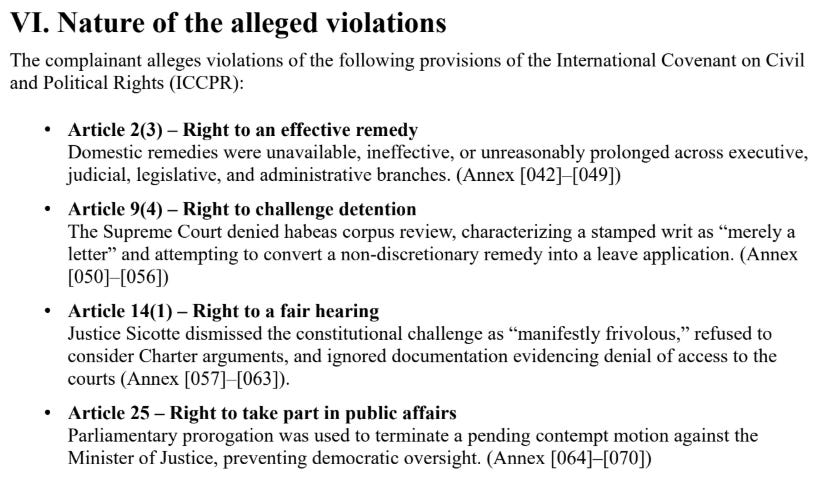
This section sets out the alleged violations of the International Covenant on Civil and Political Rights (ICCPR), linked to the factual chronology and domestic remedy analysis. Each Covenant article alleged to have been violated (Articles 2(3), 9(4), 14(1), and 25) is explained with reference to the relevant facts and supporting documents [042]–[070].
[042] Article 2(3) - Right to Effective Remedy
[043] ICCPR Article 2(3) requires States to: "(a) ensure that any person whose rights or freedoms are violated shall have an effective remedy, notwithstanding that the violation has been committed by persons acting in an official capacity; (b) ensure that any person claiming such a remedy shall have his right thereto determined by competent judicial, administrative or legislative authorities."
[044] Charter s.24(1) provides parallel domestic guarantee: "Anyone whose rights or freedoms, as guaranteed by this Charter, have been infringed or denied may apply to a court of competent jurisdiction to obtain such remedy as the court considers appropriate and just in the circumstances."
[045] Canada violated Article 2(3) through institutional failure across all branches. Executive branch provided legal advice claiming no authority under Department of Justice Act, declined constitutional enforcement procedures, and transferred matters between departments to avoid accountability.
[046] Judicial branch declined to apply Charter protections, refused constitutional questions participation, and dismissed habeas corpus applications. Judicial remedies became unavailable for constitutional challenges.
[047] Legislative branch proceedings were terminated through prorogation when other remedies had failed. Final constitutional avenue was not available.
[048] Administrative branch dismissed complaints or denied access to information. Remedy was not available across governmental institutions.
[049] This institutional pattern demonstrates how States with strong constitutional frameworks can fail to provide effective domestic remedies under ICCPR obligations, requiring international intervention under Optional Protocol.
[050] Article 9(4) - Right to Challenge Detention
[051] ICCPR Article 9(4) guarantees: "Anyone who is deprived of his liberty by arrest or detention shall be entitled to take proceedings before a court, so that that court may decide without delay on the lawfulness of his detention."
[052] Charter s.10(c) provides: "Everyone has the right on arrest or detention... (c) to have the validity of the detention determined by way of habeas corpus and to be released if the detention is not lawful." Supreme Court Act ss.35, 36, 39, 42, 43, 53, and 64 authorize habeas corpus applications to Supreme Court of Canada.
[053] Canada violated Article 9(4) through administrative dismissal of constitutional habeas corpus. Supreme Court Registry characterized stamped Writ of Habeas Corpus as "merely a letter," contrary to constitutional requirements and Supreme Court Act authorization.
[054] Court attempted to convert non-discretionary habeas corpus remedy into discretionary leave application, violating established precedent in R v. Gamble that courts must not deny Charter relief through rigid procedural rules.
[055] Institutional barriers were created to prevent constitutional challenges to judicial misconduct, rendering habeas corpus unavailable when most needed.
[056] 2023-09-07 detention resulted directly from courts' explicit exclusion of Charter protections from criminal proceedings, establishing clear causal connection between constitutional violations and subsequent imprisonment.
[057] Article 14(1) - Right to Fair Hearing
[058] ICCPR Article 14(1) guarantees: "Everyone shall be entitled to a fair and public hearing by a competent, independent and impartial tribunal established by law."
[059] Charter s.7 guarantees principles of fundamental justice. Charter s.15(1) guarantees equality before courts. Federal Court Rules establish procedural fairness requirements.
[060] Canada violated Article 14(1) through institutional bias and procedural issues. Courts favored institutional misconduct rather than ensuring impartial proceedings, demonstrating institutional concerns rather than judicial independence.
[061] Courts declined to consider Charter protections in proceedings involving judicial misconduct, creating different treatment in justice system.
[062] Court transcripts show alterations, audio evidence missing, and procedural irregularities indicate denial of fair hearing guarantees. Judge did not appear for scheduled decisions, omitted rulings, and dismissed applications without substantive review.
[063] Denial of fair hearings based on constitutional challenges establishes different treatment violating equality before courts guaranteed by both Charter s.15(1) and ICCPR Article 14(1).
[064] Article 25 - Right to Democratic Participation
[065] ICCPR Article 25 guarantees: "Every citizen shall have the right... (c) to have access, on general terms of equality, to public service in his country." More broadly, Article 25 protects right to participate in public affairs and democratic governance.
[066] Constitution Act 1867 establishes parliamentary supremacy. Charter Preamble recognizes rule of law and democratic principles. Federal courts have recognized importance of legislative-executive-judicial balance.
[067] Canada violated Article 25 through prorogation that affected democratic accountability. 2025-01-06 prorogation immediately followed 2024-12-12 contempt motion against Minister of Justice, affecting parliamentary oversight.
[068] Prorogation prevented Parliament, the only institution with authority to address judicial conduct violations, from exercising constitutional oversight when other remedies had failed.
[069] Use of prorogation affected accountability rather than facilitating democratic governance and fundamental democratic participation rights.
[070] Timing demonstrates executive-legislative interaction affecting final constitutional remedy, completing limitation of democratic participation in constitutional accountability processes.
SECTION D: LEGAL SIGNIFICANCE FOR INTERNATIONAL LAW
This section highlights the broader legal significance of the complaint under international human rights law. It explains how the Canadian case demonstrates systemic breakdown in constitutional enforcement and raises issues of precedent value for the Committee’s jurisprudence [071]–[078].
[071] Rule of Law Breakdown
[072] Charter s.52(1) declares Constitution as "supreme law of Canada," yet institutional responses prevented constitutional enforcement across all branches.
[073] Events occurred through institutional responses rather than isolated incidents, demonstrating governmental approaches to international human rights obligations.
[074] Complete breakdown of domestic constitutional protections necessitates international intervention under Optional Protocol to ICCPR when State fails to enforce its own constitutional framework.
[075] International Precedent Value
[076] This case establishes that even States with strong constitutional frameworks can fail to provide effective domestic remedies under ICCPR obligations when institutional responses prevent effective domestic remedies.
[077] Use of parliamentary prorogation that affects human rights accountability represents concern for ICCPR Article 25 democratic participation guarantees.
[078] Institutional responses across all three branches of government affecting fundamental rights represents breakdown requiring international oversight and structural reforms.
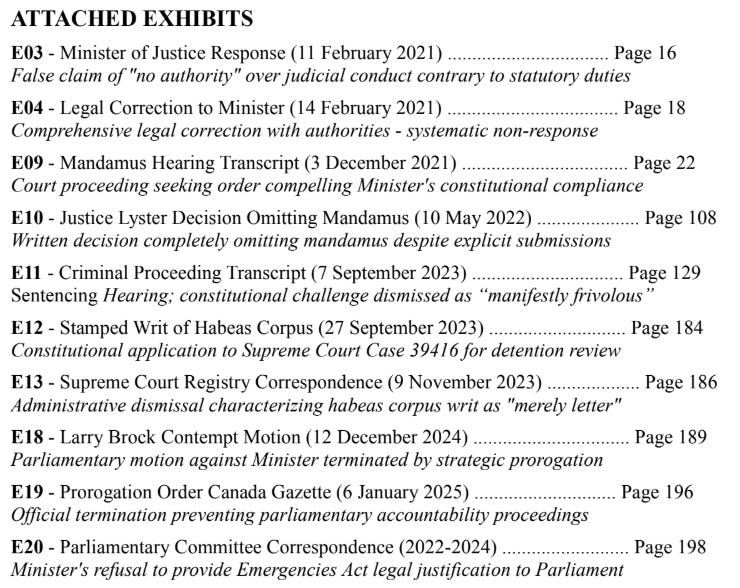
and the evidence…
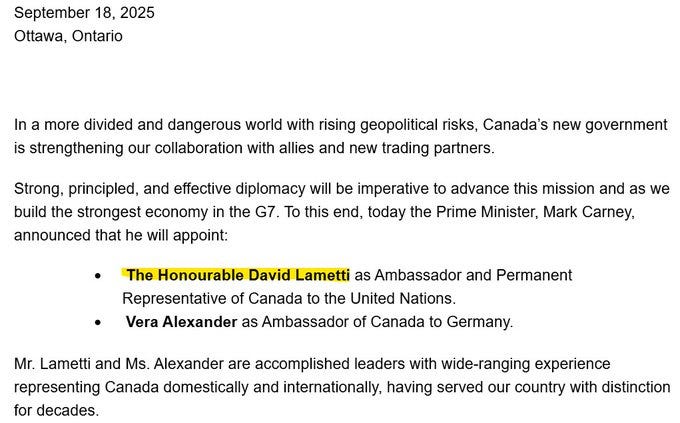
The rejection of the previous applications took under a week, as of September 18 it’s been 3 weeks now. I’ll be sure to keep you posted. I thought to keep things to myself until I received a response but today PM Carney notified the Public that he is appointing former AG/MOJ David Lametti as Canada’s Ambassador to the United Nations. I think that deserves a response.
“Strange days indeed, most peculiar brother.”
Nobody told me there’d be days like this, John Lennon.